"Pool cleaning" and "pool maintenance" get used interchangeably — but they're not the same thing. One is a subset of the other, and confusing them is how pool owners end up paying for surface-level visits that leave their equipment and chemistry neglected. Here's the actual difference, why it matters for your pool's lifespan, and what you should be getting every week.
What "pool cleaning" actually means
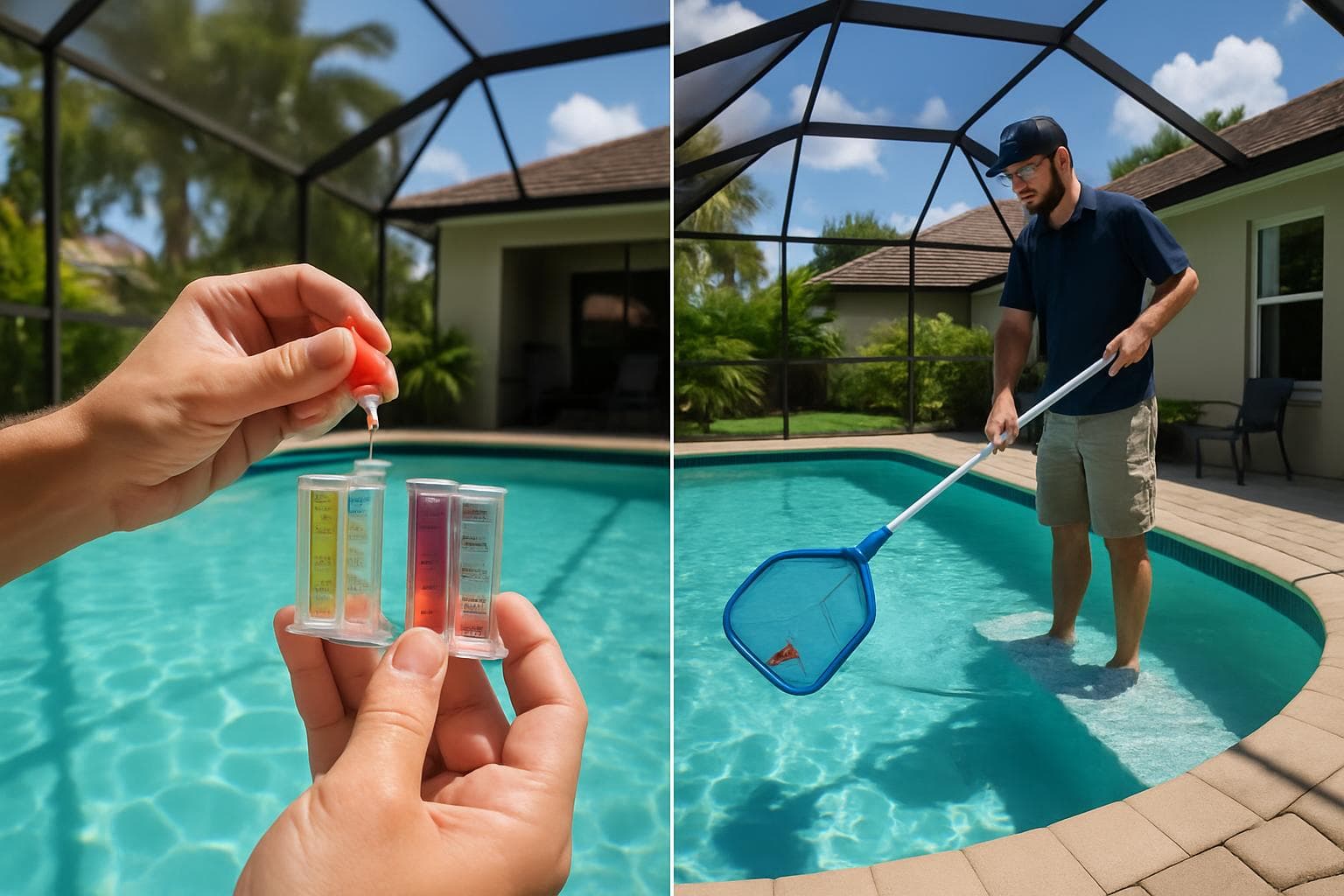
Pool cleaning is the physical removal of debris and visible contamination. It's what most people picture when they think about pool service:
- Skimming leaves, bugs, and pollen off the surface
- Vacuuming dirt and sediment from the pool floor
- Brushing walls, steps, and waterline tile
- Emptying skimmer and pump baskets
Cleaning keeps the pool looking good. It removes what you can see. But a pool that looks clean can still be unsafe to swim in — and a pool that's properly maintained but has a few leaves floating is still chemically safe.
What "pool maintenance" covers
Pool maintenance is the full scope of work that keeps a pool safe, chemically balanced, and mechanically sound. It includes cleaning, but goes well beyond it:
- Water chemistry testing — free chlorine, pH, alkalinity, calcium hardness, cyanuric acid. Not a quick dip strip — actual reagent-based or photometer readings.
- Chemical dosing — adjusting chlorine, acid, stabilizer, and salt levels based on test results, pool volume, and current weather conditions.
- Equipment inspection — checking the pump for leaks, reading filter pressure, inspecting the salt cell, verifying heater operation, and confirming the timer schedule.
- Preventive care — catching a weeping pump seal before it burns out the motor, flagging rising filter pressure before flow drops, spotting calcium buildup on salt cell plates before the cell fails.
- Documentation — same-day photo reports with chemistry readings, equipment notes, and flagged concerns.
Maintenance is what prevents the expensive problems. Cleaning is one component of maintenance — necessary but not sufficient.
Why the difference matters for your wallet
According to the Pool & Hot Tub Alliance (PHTA), the average pool owner spends $1,200–$3,600 per year on maintenance — but that excludes equipment repairs and replacements. A single pump replacement runs $800–$2,500, and a replaster costs $5,000–$15,000 (PHTA 2023 Market Report). Proper weekly maintenance is what prevents most of those major expenses.
The cost difference between a cleaning-only visit and a full maintenance visit is small — maybe $20–$40 per month. The cost difference in outcomes is massive:
- Pump failure from ignored seal leak: $600–$900 for a new variable-speed pump. A seal replacement caught early costs $80.
- Algae bloom from unchecked chemistry: $350–$800 for a professional green-to-clean recovery. Weekly chemical dosing prevents it entirely.
- Plaster damage from pH drift: $4,000–$12,000 for resurfacing. Weekly pH monitoring keeps plaster healthy for 12–15 years.
- Salt cell death from calcium buildup: $400–$700 for cell replacement. Quarterly acid baths extend cell life by 2–3 years.
Every dollar spent on proper maintenance saves $10–$20 in avoided equipment and surface repairs. That's not marketing — it's the math we see on every route in St. Petersburg and Clearwater.
Why Florida pools need maintenance, not just cleaning
Florida has 1.59 million residential pools — more than any other state (PHTA). In the Tampa metro area, 27.7% of homes have a pool (LendingTree/AQUA Magazine). The sheer density means local providers compete on price, which tempts some to cut scope to "cleaning only." Don't fall for it.
Florida's climate makes the cleaning-vs-maintenance distinction sharper than anywhere else in the country:
- Year-round algae pressure— pool water hits 85°F+ by mid-April and stays there through October. Algae doubles every 4–6 hours at zero chlorine in warm water. Cleaning alone doesn't address chlorine levels.
- UV chlorine degradation — Pinellas County UV intensity degrades unprotected chlorine at roughly 75% per day during peak sun. Without proper CYA monitoring, even freshly dosed pools lose their sanitizer within 24 hours.
- Salt-air corrosion — coastal pools in St Pete Beach, Clearwater Beach, and the barrier islands need equipment hardware inspected weekly. A cleaning-only visit won't catch corroding pump housings or failing salt cell plates.
- Hurricane season — proper maintenance includes pre-storm protocols that protect equipment. Cleaning-only providers don't offer this.
What to ask your current pool service
If you're not sure whether you're getting cleaning or full maintenance, ask these four questions:
- Do you test all six chemistry parameters every visit?(Free chlorine, total chlorine, pH, alkalinity, calcium hardness, CYA.) If the answer is "we check chlorine and pH," that's a cleaning visit, not maintenance.
- Do you inspect the equipment pad every visit? Pump, filter pressure, heater, salt cell, timer. If they don't walk the pad, equipment problems go unnoticed.
- Do you send a photo report with chemistry numbers?If not, there's no accountability for what happened during the visit.
- What happens when something needs attention between visits?Full maintenance providers flag issues proactively and communicate directly with you — they don't wait until the pool turns green.
What Pool Optics includes in every weekly visit
Every weekly pool maintenance visit from Pool Optics covers the full 8-point checklist: surface skimming, floor vacuuming, wall brushing, basket cleaning, full chemistry testing, chemical dosing, equipment inspection, and a same-day photo report. Same technician, same day, every week.
We don't offer a "cleaning only" tier because cleaning without maintenance is how pools develop expensive problems. Every customer gets the full scope.
Serving St. Petersburg, Clearwater, Tampa, Largo, and all of Pinellas County. Send a quote request or call (352) 586-0364 — Jacob responds within a few hours during business days.
Frequently asked questions
What is the difference between pool cleaning and pool maintenance?
Pool cleaning is the physical removal of debris — skimming, vacuuming, and brushing. Pool maintenance includes cleaning but also covers water chemistry testing, chemical dosing, equipment inspection, and preventive care. Cleaning makes the pool look good; maintenance keeps it safe, chemically balanced, and mechanically sound.
Is pool maintenance more expensive than pool cleaning?
Full weekly pool maintenance runs $130–$200/month in Pinellas County — only $20–$40 more than a cleaning-only service. The cost difference is minor, but the savings from avoided equipment failures, algae recoveries, and surface damage can be $1,000–$5,000+ per year.
How often should a Florida pool be maintained?
Weekly, year-round. Florida's heat, UV intensity, and year-round algae pressure mean a single skipped week can drop chlorine to zero and turn a clear pool green in 3–5 days. Biweekly maintenance does not work in Florida's climate.
What should be included in weekly pool maintenance?
A complete weekly visit should include surface skimming, floor vacuuming, wall brushing, basket cleaning, full chemistry testing (six parameters), chemical dosing, equipment pad inspection, and a same-day photo report with documented readings.
Can I do pool maintenance myself or should I hire a service?
DIY pool maintenance is possible but requires 4–6 hours per week and a solid understanding of water chemistry. Most DIY pool owners in Florida skip the less visible steps — chemistry beyond chlorine, equipment inspection, documentation — and those are exactly the steps that prevent expensive failures.