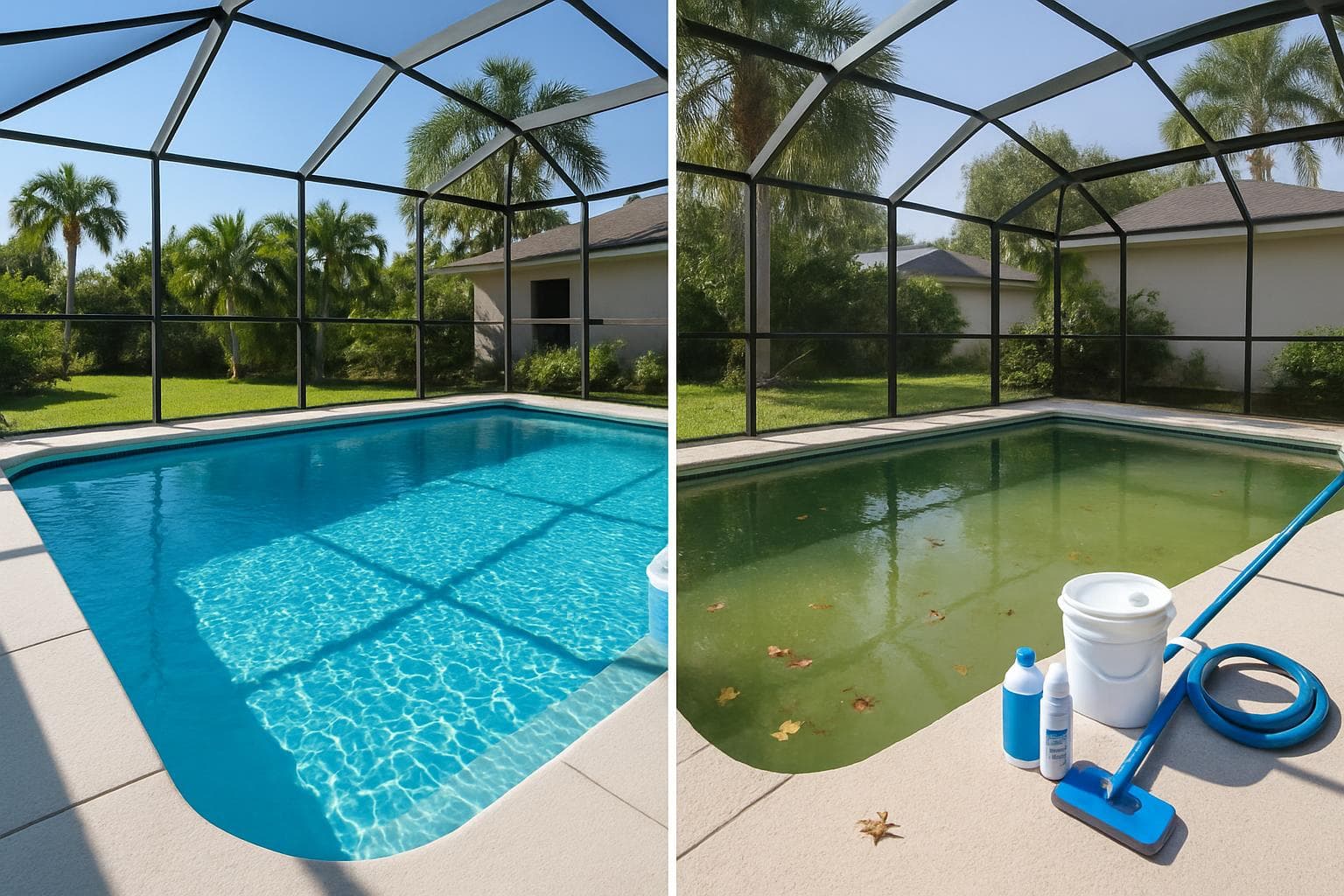
DIY pool maintenance looks cheaper on paper — a bucket of chlorine tabs, a test strip kit, and a Saturday morning routine. Until you factor in four to six hours a week of labor, chemistry mistakes that kill equipment early, and the algae bloom that turns your pool green the one week you skip. Here's the real cost comparison, not the marketing version.
The real monthly cost of DIY pool maintenance
Most DIY pool owners undercount their costs because they only track what they buy at the pool store. Here's what a standard 15,000-gallon chlorine pool actually costs to maintain yourself in Central Florida:
- Chlorine — liquid chlorine or tabs: $40–$60/month in summer, $20–$35/month in winter.
- Muriatic acid — pH adjustment: $8–$15/month.
- Stabilizer (CYA) — added a few times per year, amortized: $5–$8/month.
- Test kits and reagents — a proper reagent kit lasts 6–12 months: $5–$10/month amortized.
- Specialty chemicals — algaecide, phosphate remover, clarifier, calcium hardness increaser as needed: $5–$15/month on average.
- Tools and equipment — leaf net, vacuum head, hose, brush, pole, replacement parts: $10–$20/month amortized.
Total visible DIY cost: $75–$130/month.That number surprises most homeowners — they expected $30–$40. The gap between perception and reality is the first crack in the "DIY saves money" argument.
What weekly professional service actually costs
Professional weekly pool service in St. Petersburg and Clearwater runs $130–$200/month for most residential pools. The exact price depends on pool size, equipment type (salt vs. chlorine, heater, attached spa), debris load, and proximity to the coast.
That monthly fee includes all standard chemicals (liquid chlorine, muriatic acid, CYA, salt), all labor, equipment inspection, and photo reporting. For a detailed breakdown of what's included, see our guide on what weekly pool service actually covers.
The sticker price gap between DIY and professional service is $30–$70/month for most pools. That gap closes fast when you account for time and hidden costs.
The time cost nobody accounts for
Proper DIY pool maintenance takes 4–6 hours per week when done correctly:
- Skimming and vacuuming: 45–60 minutes
- Chemistry testing and dosing: 30–45 minutes
- Brushing walls, tile, and steps: 25–30 minutes
- Basket and filter checks: 15–20 minutes
- Supply store trip (every 2–3 weeks): 30–45 minutes per trip
- Research and troubleshooting: variable, often 30+ minutes when something looks wrong
At any reasonable hourly valuation of your time — $25, $50, $100 — the math tilts hard toward professional service. Four hours a week at $25/hour is $400/month in labor alone. That's 2–3× the cost of hiring a pro.
And that 4–6 hour estimate assumes you're doing it right. Most DIY owners skip steps because the full routine is tedious. The steps they skip are the ones that prevent the expensive problems below.
The hidden costs of DIY: equipment damage
This is where the real money lives. Chemistry mistakes don't announce themselves immediately — they compound silently over weeks or months, then show up as a four-figure repair bill.
- Premature pool resurfacing — improper acid use or chronic low pH dissolves plaster and pebble finishes. Resurfacing cost: $4,000–$12,000 depending on pool size and finish type. See our resurfacing guide for what drives that number.
- Salt cell killed by high CYA — running CYA above 80 ppm forces the salt cell to work overtime, burning out plates in 2 years instead of 5. Cell replacement: $400–$900. Our salt cell replacement guide covers the warning signs.
- Heater corrosion from low pH — running pH below 7.0 corrodes copper heat exchangers. Heater replacement: $2,500–$5,500 installed.
- Algae recovery — a green pool from a skipped week costs $350–$800 for a professional deep clean, or $150–$300 in chemicals and 8–12 hours of your time if you handle it yourself.
The average DIY pool owner in Florida experiences one of these events every 1–3 years. On a per-month basis, that adds $25–$70/month in amortized hidden costs — which wipes out the entire savings over professional service.
The 5 most expensive chemistry mistakes DIY owners make
These are the mistakes we see most often when taking over pools from DIY owners:
- Letting CYA creep above 80 ppm — happens when trichlor tablets are the only chlorine source. CYA builds endlessly because tabs add stabilizer with every dose. Once CYA passes 80, chlorine locks up and stops killing algae effectively. The only fix is a partial drain.
- Running pH above 7.8 for weeks— seems minor, but at pH 7.8 only 30% of your chlorine is in its active form. At 8.0, it drops to 20%. The pool looks fine until algae suddenly explodes because there's no functional sanitizer.
- Ignoring calcium hardness — Florida fill water is moderately hard. Without periodic testing, calcium concentrates from evaporation. Above 600 ppm, calcium precipitates as white scale on tile, equipment, and the salt cell.
- Using trichlor as the only sanitizer— this combines problems #1 and #2. Trichlor crashes pH (acidic) AND builds CYA simultaneously. It's convenient but it's the single biggest cause of cascading chemistry failure in residential pools.
- Ignoring phosphates— phosphates don't directly harm the pool, but they're algae food. Pools with 500+ ppb phosphates require more chlorine to maintain the same residual, which costs more and strains equipment.
All five of these are slow-burn problems. They don't show visible symptoms for weeks or months, which is why DIY owners miss them until the damage is done. A CPO-certified tech catches these on the first chemistry test. If you're dealing with the aftermath of any of these, our cloudy pool diagnosis guide covers the symptoms and fixes.
When DIY pool maintenance actually works
DIY is a reasonable choice under specific conditions:
- You have a small pool (under 10,000 gallons) with minimal equipment
- You have genuine chemistry knowledge — not YouTube confidence, but actual understanding of the LSI and chlorine/CYA ratio
- You have 4–6 hours per week available consistently, including through summer heat
- You own a proper reagent test kit (not strip tests) and use it every week
- You're willing to invest in equipment repairs proactively rather than waiting for failure
If all five are true, DIY can work and save you $30–$70/month on the visible costs. If even one is missing, the hidden costs will likely exceed the savings within a year.
The hybrid approach: DIY skimming + professional chemistry
Some homeowners split the work: they handle daily skimming and basic debris removal between visits, and the professional handles chemistry, equipment checks, and the precision work.
This works well for owners who enjoy being in the backyard but don't want to manage chemistry. The professional still comes weekly for the full checklist, but the pool stays cleaner between visits because the owner is pulling debris daily.
What doesn't work is reducing professional visits to biweekly to save money. In Florida summer, two weeks between chemistry checks is too long. Algae, chlorine loss, and equipment problems all move faster than a biweekly schedule can catch.
The bottom line
Here's the honest comparison for a typical 15,000-gallon residential pool in Pinellas County:
- DIY visible cost: $75–$130/month in chemicals and supplies
- DIY hidden cost: $25–$70/month in amortized equipment damage from chemistry mistakes
- DIY time cost: 16–24 hours/month of labor
- Professional service: $130–$200/month, all inclusive, zero hours of your time
The total cost of ownership is comparable or lower with professional service — and you get your weekends back. If you're ready to make the switch, send a quote request or call (352) 586-0364. Jacob responds within a few hours during business days. First month is free for new weekly customers. For more on choosing the right provider, read our guide on how to choose the best weekly pool service in St Petersburg.
Frequently asked questions
Is it cheaper to clean my pool myself or hire a service?
On paper, DIY saves $80–$120/month vs professional service. In practice, most DIY pool owners in Florida spend $60–$100/month on chemicals alone, plus 4–6 hours per week of labor, plus an average of $300–$800/year in equipment damage from chemistry mistakes — making the real cost comparable or higher than professional weekly service.
How much time does DIY pool maintenance take per week?
Expect 4–6 hours per week for proper DIY pool maintenance: skimming and vacuuming (45–60 min), chemistry testing and dosing (30–45 min), brushing walls and tile (30 min), basket and filter checks (20 min), plus one supply-store trip. Most homeowners underestimate this by half because they skip steps that a professional wouldn't.
What are the hidden costs of DIY pool maintenance?
The three biggest hidden costs: premature equipment failure from chemistry imbalances ($500–$2,000 per incident), algae recovery treatments from skipped weeks ($350–$800 per event), and pool surface damage from improper acid use or calcium neglect ($4,000–$12,000 to resurface). None of these show up in a monthly chemical budget.
What pool chemistry mistakes do DIY owners make most often?
The top three: letting cyanuric acid climb above 80 ppm (locks up chlorine and renders it ineffective), running pH above 7.8 for weeks (accelerates calcium scaling and plaster damage), and using trichlor tablets as the only sanitizer (crashes pH and builds CYA simultaneously). All three are slow-burn problems that don't show symptoms for months.
Can I do some pool maintenance myself and hire a service for the rest?
Yes — a hybrid approach works for some owners. You handle skimming and basic debris removal between visits; the professional handles chemistry, equipment checks, and the precision work. Some providers offer every-other-week service to support this, but in Florida summer, weekly professional chemistry is the minimum for safe water.